

Key takeaways
- Incidents of hybrid warfare in Europe – excluding drone incursions – dropped in 2025 after hitting a high in 2024.
- There are a few possible explanations: European intelligence agencies may be better at blocking attacks, the Kremlin may be looking to achieve its objectives in Ukraine via negotiations with the US, or Russia could have decided to re-evaluate its hybrid-warfare strategy.
- Incidents of hybrid warfare risk increasing in 2026 with large-scale attacks and influence operations as elections approach in several European nations including France.
Human rights activist Vladimir Ossetchkine was preparing dinner with his wife and children at their home in Biarritz when he noticed a small red dot travelling across the room. Then it zeroed in on him.
Ossetchkine immediately threw himself to the ground, as did his family – all of whom managed to survive the September 12 assassination attempt.
One month later, four French residents were charged with trying to kill Ossetchkine, who is the director of an NGO that advocates for human rights in Russian prisons and who has lived in France since fleeing Russia 10 years ago.
‘Irregular, covert operations’
Were the Biarritz snipers working on the Kremlin’s orders? Some of those arrested were originally from Dagestan, a Russian republic in the North Caucasus, according to an AFP source. `
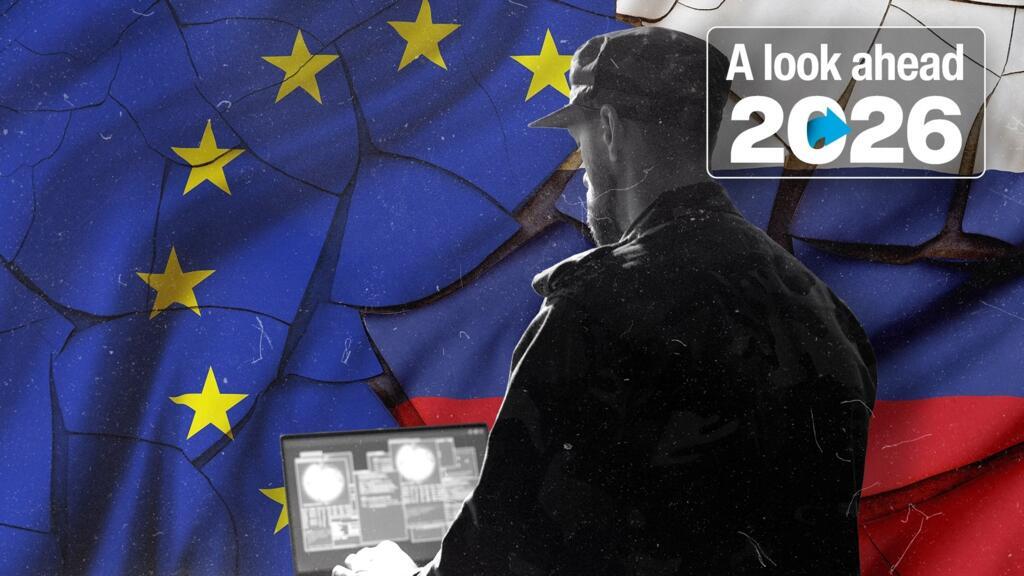
Since Russia’s full-scale invasion of Ukraine in early 2022, President Vladimir Putin has been accused of orchestrating a vast hybrid-warfare campaign in Europe, including several assassination attempts.
Assassins operating under the Kremlin’s orders are suspected of trying to kill the CEO of Rheinmetall, a German arms manufacturer sending weapons to Ukraine.
FSB Russian intelligence is suspected of coordinating an attempt by six Bulgarians based in the UK to kidnap investigative journalist Christo Grozev and deliver him to Russian operatives.
Three of the group were found guilty by British courts on espionage charges.
But Russia’s hybrid-warfare strategy makes it difficult to trace operations directly back to Moscow.
“An essential characteristic of a hybrid operation is that it is deniable, that you’re not sure who is behind it,” says Bart Schuurman, a specialist in political violence at Leiden University in the Netherlands, who is part of a research group compiling a list of hybrid warfare operations targeting Europe.
Across the European continent, a diverse range of hybrid-warfare attacks garnered headlines in 2025, including drone incursions around airports, the sabotage of Polish railways, pigs’ heads left outside mosques in Paris, anti-Semitic acts and assassination attempts.
Read moreDrones, sabotage, surveillance: Moscow’s hybrid warfare takes to the high seas
Russia’s hybrid-warfare campaign appears focused on punishing Europe for its support of Ukraine by destabilising European society, driving wedges between communities and attempting to fracture support for its battlefield adversary.
Schuurman says Moscow’s hybrid campaign is “an attempt to further divide Europe”.
Sabotage, cyber-attacks, vandalism and influence operations “are all an attempt to undermine public and political support for Ukraine in Europe, ultimately helping Russian soldiers win the war”, he adds.
“Hybrid warfare attempts to support what Russia is doing on the battlefield in Ukraine using irregular or covert operations,” he says.
Threatening the CEO of Germany’s Rheinmetall directly sends the message that there is a price to pay for supporting Ukraine.
‘Detecting plots’
The hybrid-warfare attacks began in earnest in 2022, coinciding with the full-scale invasion of Ukraine – which Putin reportedly believed would be complete within 10 days.
As the war dragged on, Schuurman notes, hybrid attacks attributed to Russia became more frequent in 2023 and even more so in 2024. “Initially, Russia had hopes that it could win quite simply on the battlefield alone. And as it got more difficult for them to do so, they were looking for other ways to increase their chances of success.”
Overall, 2025 saw a drop in hybrid-warfare operations, despite headline-grabbing incidents like drones closing down airports around Copenhagen and Oslo.
Read moreDenmark drone incursions: All signs point to Russia?
“If we look at the more classic techniques like influence, sabotage, arson, vandalism and terrorism, we’re looking at about half of what we saw last year,” says Schuurman.
But why would Russia scale back such efforts when the war in Ukraine is ongoing?
“Maybe there’s less of a need for hybrid warfare,” Schuurman says, noting that Russia may be hoping to achieve what it wants through peace negotiations led by the administration of US President Donald Trump.
Moreover, Europe might be getting better at counter-operations.
“European intelligence services have been facing this Russian hybrid threat for a few years, and they have learned how to adapt to it. They’ve gotten a lot better at detecting plots before they happen,” Schuurman says.
Three Ukrainians were arrested in Germany in May, accused of trying to send packages of explosives on Moscow’s orders. One year earlier, a similar operation resulted in several packages exploding while they were being transported by postal service DHL.
The success of negotiations between Moscow and Washington are likely to dictate whether the Kremlin expands its hybrid-warfare operations in the months ahead, says Schuurman. “If the whole thing falls apart, I think we will see a return to more hybrid operations.”
An increase in operations is also possible if the US decides to withdraw support for Ukraine, he says, “which seems to be more and more likely” under the new administration.
“Then Europe will be more alone, and I think we can expect more tests by Russia to see if it is an opponent to take seriously or not.”
This could also mean that attacks might become more ambitious in scale – and could continue to test the resolve of Europeans, even if Putin gets what he wants in Ukraine.
A target of particular concern is elections, which Moscow have repeatedly tried to influence in favour of extremist parties.
France faces a key municipal vote in 2026 and a presidential election in 2027, with several European nations also set for elections in the coming year.
This article was adapted by Joanna York. Click here to read the original in French.