

Africa’s e-mobility battle is no longer about the bike. It’s about who owns the network.
E-mobility players, including Roam and Ampersand, are increasingly focusing on expanding their battery-swapping networks to unlock scale.
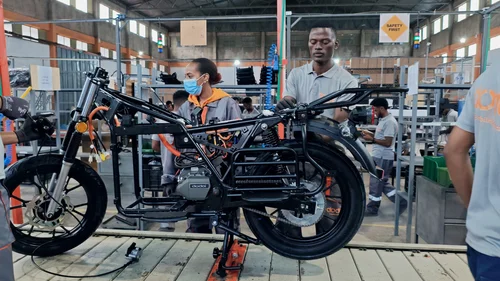
Dodai, an Ethiopia-based electric motorbike startup, has raised $13 million to scale battery-swapping infrastructure across Addis Ababa. The round—$8 million equity, $5 million debt—includes backing from British International Investment (BII) and a cluster of Japanese investors: UTokyo Innovation Platform, Nagase, and CBC Co.
The investor mix is worth noting. Japanese capital is financing the buildout. Chinese hardware—battery cells, motors, controllers—is likely running underneath it. Africa’s EV value chain is increasingly bifurcated this way: foreign investors provide the risk capital, foreign manufacturers supply the components, and local startups like Dodai navigate the gap. Local assembly is not the same as local manufacturing, and the distinction matters when asking who actually captures long-term value.
What Ethiopia provides, uniquely, is policy certainty. A 2024 ban on private internal combustion engine (ICE) vehicle imports—later extended to trucks—has put roughly 100,000 EVs on its roads. That removes the adoption problem most e-mobility startups spend years trying to solve elsewhere. It also makes battery-swapping infrastructure essential rather than experimental. When riders can’t fall back on petrol, a depleted battery becomes a business emergency. Dodai’s network becomes critical infrastructure, not a convenience feature.
But the capital math is uncomfortable. Dodai plans 1,000 battery-swapping stations across Addis Ababa within three years. At conservative estimates of $112,000 per station, according to The Conversation, that’s $112 million in infrastructure spend. When you view it from that lens, the $13 million looks like a down payment, not a destination.
Yet, Dodai is betting on a philosophy: Scale fast enough, and you don’t just serve the market—you set the terms for how it runs. With its plan to deepen its Ethiopia play, it is moving first and wide before most other e-mobility operators catch up on the opportunity that exists in the market. But getting there will require multiples of what’s been raised.